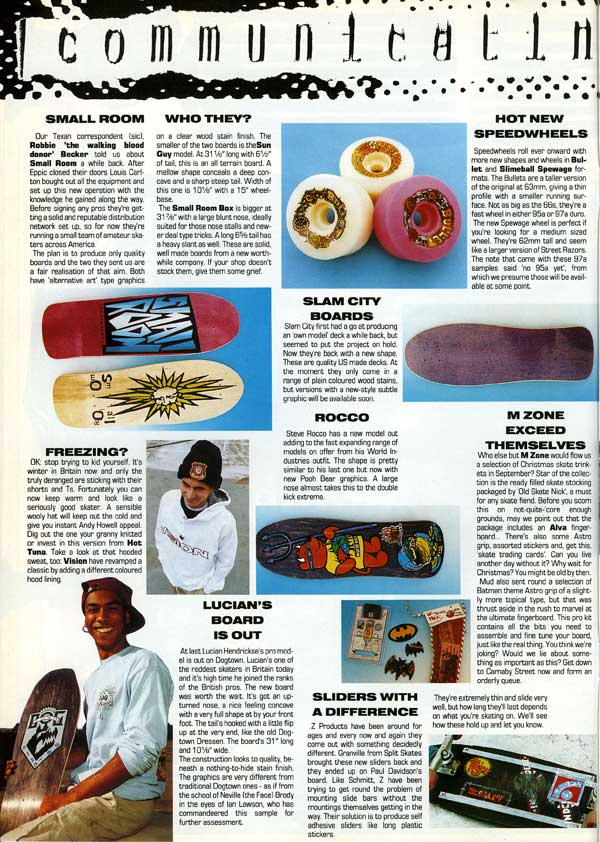
 Vernon Adams, I salute you (and that’s him modelling the Hot Tuna beanie). The products page was always a difficult one for us. Most consumer magazines are all about selling objects of desire, but we were not. In the seventies Skateboard! magazine had set out down that path, with Dave Goldsmith writing technical pieces about urethane and so on. Steve Kane continued the tradition with the reincarnation of that magazine and when that came to an end the sacred Durometer actually passed to us. But it was the skating, not the equipment which really interested us and so we had a struggle getting excited about new graphics on decks. Vernon put a lot of work into each month, and we kept fiddling around with the format (colour this time), but the products page always seemed to stand out as different from the rest of the magazine.
2 responses to “New Skateboard Products, November 1989 R.a.D Magazine”
I loved the new products page – always new stuff to dream about or add to the “next deck” list.
The Rocco board also emotes a time of variable quality wood used in decks – H-Street wood was really bad at one point but you just had to have those decks, Santa Cruz wood was always pretty good in my experience and what about Bone-ite?!?!
Powell/Peralta adding cardboard with a missconception that skaters would appreciate a lighter board and not mind the fact that a British climate (wet) would ruin the deck in a matter of days? ah those were the days…..
One of the reasons I was wary of including anything remotely like technical reviews was because there was so much variability. Take that “durometer” business, for example: we used to have one at Alpine Sports, so I knew from experience that it was easy to produce different readings from wheels from the same box. That’s not to say that the wheels themselves varied (though they probably did), but that errors could be introduced by bad testing.
In the same way, comments about the concave of one deck in the days when the things might be pressed in batches of ten at a time could have given the wrong idea.
So we stuck to pictures. And graphics were always food for dreams.